

Herbivore Impact and Management Update
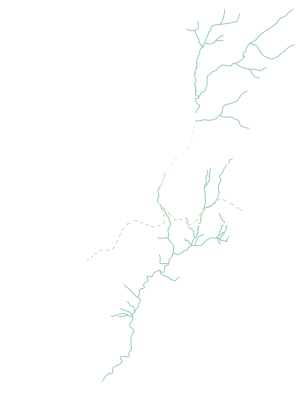
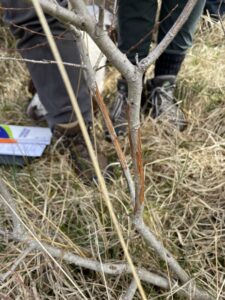
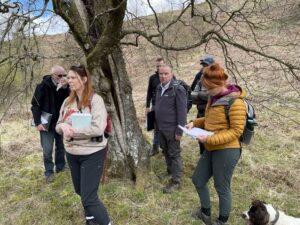
We have been busy undertaking herbivore impact assessment across the reserve over the autumn and winter which has taken us to some of the far corners of the Tarras Valley to help get a scientific landscape-scale picture of what’s going on. We have been using the industry standard Herbivore Impact Assessment Methodology which helps to assess grazing pressure from herbivores like sheep,
deer and feral goats.
This is focused on monitoring impact in wood pasture, existing woodland, regenerating mixed habitats and riparian zones. It looks at what is being browsed, and to what level, all to help give an indication about whether the system is in balance or not and inform sustainable management approaches.

Herbivore grazing is an important tool in helping to create a diverse and dynamic mosaic of habitats where nature can recover and thrive, but it does require careful management to keep things in healthy balance. Over-grazing can be just as damaging as under-grazing on sensitive or recovering habitats.
The sort of surveys we have been carrying out help determine how to get the balance right between animal disturbance and vegetation succession – which, if achieved, helps to generate a rich habitat complexity, and protects and boosts biodiversity.
The initial results of our survey plots across the Valley have highlighted that there are areas of the reserve which are under significant grazing pressure. There is a need to intervene in some areas with culling to help reduce the pressure and encourage a
more sustainable balance on the land.

Alongside this, we are looking at diversifying the grazing animals we have on Tarras Valley Nature Reserve, to include more native cattle and fell ponies. We hope to graze rotationally and move from a set stocked system to build much longer periods of rest into the pastures, which will aid regeneration and recovery of the soils and vegetation to boost biodiversity and productivity.
We are also looking at a transition to regenerative grazing for our kept herbivores. This includes trying to help reduce inputs like medication, moving to a grass-fed system.
Since our statement in September last year, which you can read here Feral goats – Tarras Valley Nature Reserve, we have not changed our approach. We have been undertaking a cull of feral goats to help bring their numbers down to a more sustainable, smaller and healthy population across Tarras Valley. Culling is not a decision that was taken lightly, and our approach has consistently been to only use lethal control as a last resort. But in the absence of any natural predation, it is a necessary activity and part of responsible land ownership.
In autumn 2025 we contracted experienced and licensed stalkers to humanely cull 115 feral goats as part of our aim to reduce the growing population of feral goats on Tarras Valley by an initial 20% between 2025-2026. The cull will continue this autumn in order to meet our cautious target. As happened historically, culling is restricted to the autumn months.
As part of our ongoing herbivore management, we also have culled 30 roe deer in our woodland areas using an experienced stalker. This has been to help reduce grazing pressure on regenerating habitats especially in former ancient woodland sites.
We will keep reviewing our approach going forward to assess numbers and impact on the ground using surveys such as herbivore impact assessment to ensure balance with the land’s carrying capacity, and to ensure the long-term health and welfare of the reserve’s herbivore populations.