

Updated statement on feral goats
Current position statement regarding feral goats on Tarras Valley Nature Reserve
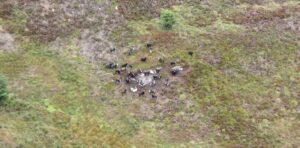
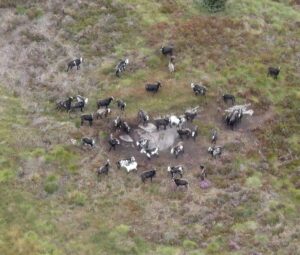
The 10,500 acres of the Langholm and Newcastleton Hills owned by the Langholm Initiative charity are inhabited by a free roaming population of feral goats, which move frequently across multiple landholdings. The feral goats are not a native species to the UK; their origins are unknown.
Grazing animals have a role to play in the management of our landholding to support nature restoration. As with any wild or feral grazing herbivore population in the UK – for example, deer or feral goats – in the absence of natural predation, it falls to people to manage their numbers to ensure things are kept in balance.
There has always historically been population management of feral goats and deer on the moor to keep numbers at sustainable levels. Prior to our community buy-out in 2021, the 2014 records show the goat population was reduced to a target of 100 individuals.
Post buy-out, population management was put on hold to allow us to learn more about the land and the goats to assess their impacts, whether positive or negative, and to avoid unnecessary culling. Our approach is to only use lethal control of animals as a last resort.
As part of this, we have been undertaking an ongoing Herbivore Impact Assessment and carrying out goat population counts. It is important to understand the impacts of herbivores on the land as well as their numbers. Over-grazing can be just as damaging as under-grazing on sensitive or recovering habitats.
We estimate the feral goat population on the Tarras Valley has now reached 800 to 900 individuals – a population increase of up to 800% in just over 10 years. The overall population across the wider area is likely to be even higher as this is just what has been observed on our own landholding.
Without management intervention, this unchecked and exponential population growth will continue as the feral goats continue to breed.
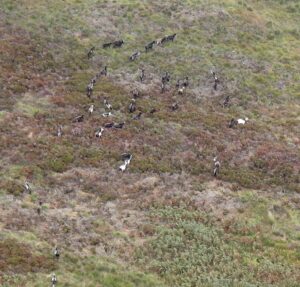
Now we have a clearer picture, it would be irresponsible to allow this population of animals to continue to breed unchecked with no management intervention.
We know how much people care and we acknowledge the strength of feeling over this issue, but without management, the population will continue to rise until food shortage or disease become an issue. Management is important for the long-term health and welfare of the feral goat population.
Unchecked population growth will lead to significant damage to the reserve as the feral goats breed beyond the natural carrying capacity of the land and we have a responsibility to consider the whole system.
Our aim is to keep a healthy, smaller, sustainable population of feral goats on the land.
To achieve this – while recognising there are no easy answers – we aim to reduce the population of feral goats on Tarras Valley by an initial 20% over the next two years. As happened historically, this would be by culling in the autumn months. As much as possible,
we will seek to focus management on any sick, old or weak individuals.
This management approach will be reviewed going forward to assess numbers and impact on the ground to ensure balance with the land’s carrying capacity.
This is not a decision that has been taken lightly and as with all land management decisions we know this will be met with both agreement and disagreement.
We are a small local charity with a small staff team, and we are trying to sensitively navigate this complex situation which has extended way beyond the town and into a national arena.
We know not everyone will agree but there needs to be space made to respect each other and to respect different points of view.
We will continue to engage with the local community over the coming months as we develop our herbivore management plan.
If you would like more information, you can access our FAQ’s document below.