
Future Peatland Restoration on Tarras Valley
Future Peatland Restoration on Tarras Valley
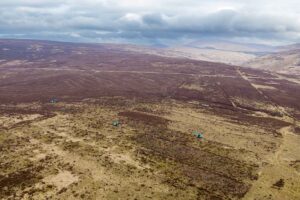
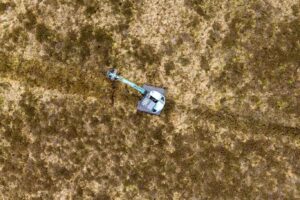
It’s nearly been a year since phase 1 of the Tarras Valley peatland restoration programme completed on Middlemoss Head which blocked up 54km of artificial moorland drains and profiled exposed peat to help prevent further erosion. The area has been holding lots of extra water during both the summer and winter months!
We’ve now started development work with Dumfries based Crichton Carbon Centre as part of the national Peatland Action programme on phases 2 and 3 of future restoration works which we hope will be a multi-year programme. The development work will involve extensive survey and assessment on site to inform a restoration design plan for the areas. The aim of it all is to help to restore natural hydrology, returning the dried-out peatland to its natural bog-like state and creating a mosaic of habitats that will allow a range of species to thrive including birds, insects and rare plants. With increasing extremes in our climate being experienced from extreme heat to flood, we hope that doing this important work to restore natural hydrology will build the natural resilience of the land to help with adaptation to our changing climate.
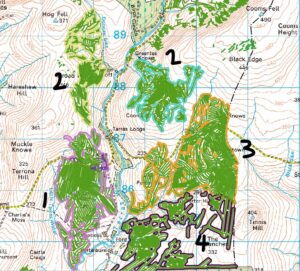
A summary of what’s within the two phases is as follows. These figures may increase or decrease slightly once our surveys are underway and the design is finalised and the team have had more time on the ground doing survey.
- Phase 2 will cover approximately 217 hectares with roughly 56km of drainage works.
- Phase 3 will cover approximately 255 hectares and roughly 79km of drainage works.
Once things are a little bit further on with the development work, we’ll organise a community drop in event just so anyone interested or who has any questions can come along and find out more.
We’re really looking forward to working with our partners at Crichton Carbon Centre on what are two more ambitious phases of our peatland restoration on Tarras Valley!
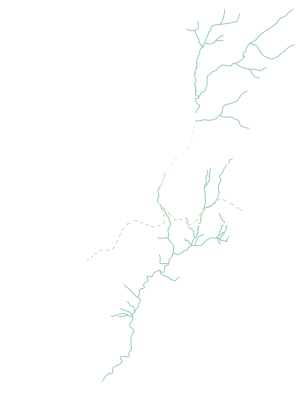
*Map shows the areas of artificial moorland drains which have been mapped by the Crichton Carbon Centre and includes the labelled phases of the peatland restoration works*